How to Start an Online Business: A Beginner’s Guide
Have you ever thought about starting an online business but had no idea where to begin?
Maybe you have an idea for a product, a creative skill, or something you would like to sell online. The problem is figuring out what to do first.
Starting an online business does not have to mean building a huge website, buying lots of inventory, or having everything figured out before you begin. You can start small, learn as you go, and build your business step by step.
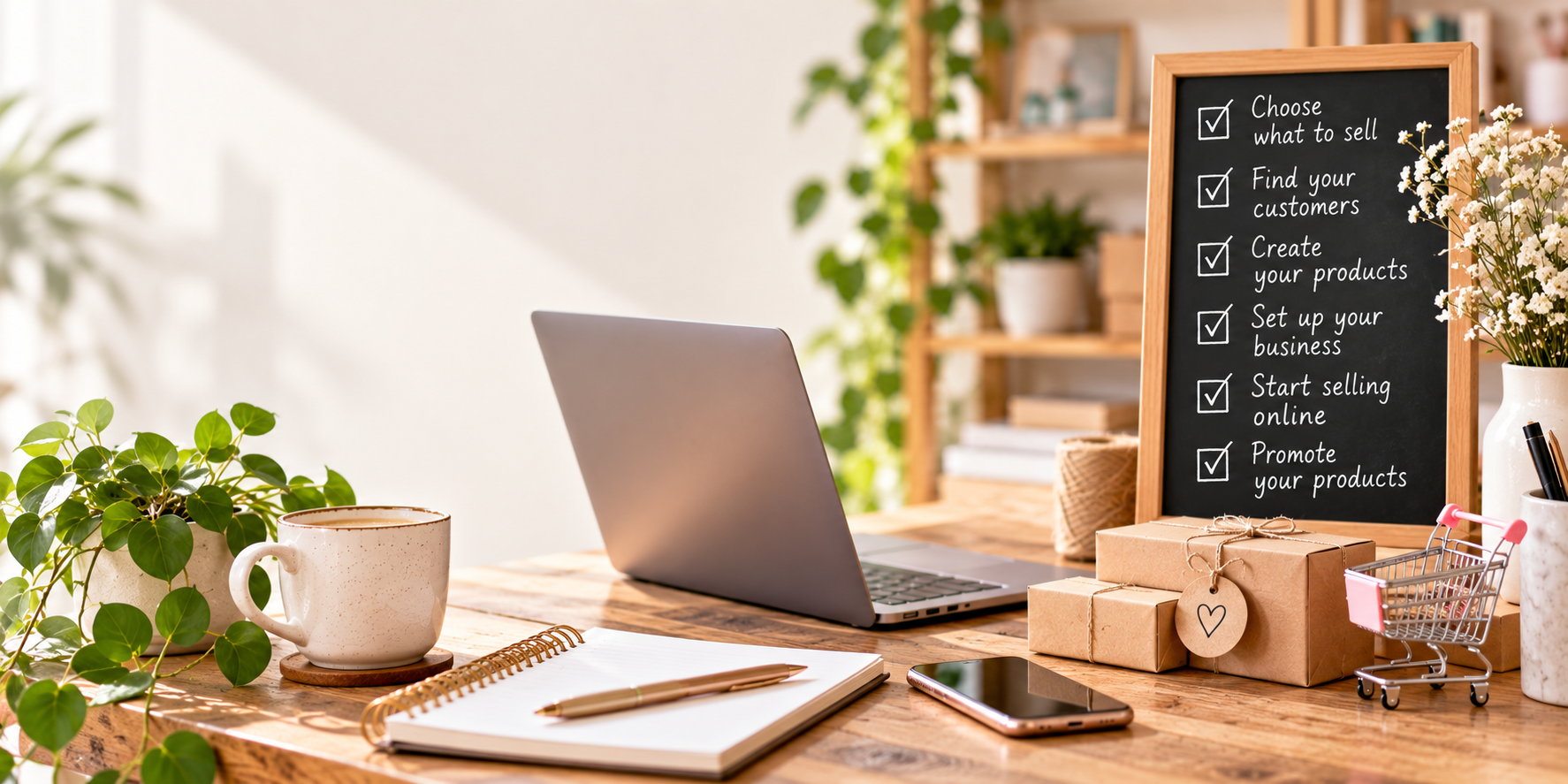
In this beginner’s guide, you will learn how to start an online business, including how to choose what to sell, identify your customer, create your products, set up your business basics, choose where to sell, and promote your products.
What Is an Online Business?
An online business is a business that uses the internet to sell products or services, communicate with customers, or deliver products digitally.
There are many different types of online businesses. For example, you could sell:
- Handmade products
- Clothing and accessories
- Jewelry
- Artwork
- Home and living products
- Books and paper goods
- Digital products
- Beauty and personal care products
- Food products
- Vintage items
- Educational content or courses
- Services
You do not necessarily need a large company, office, or team to get started. Many businesses begin with one person, one idea, and a small selection of products or services.
The important thing is to start with a realistic plan and understand what you need before you begin selling.
Step 1: Choose What You Want to Sell
The first step in starting an online business is deciding what you want to sell.
This may sound simple, but it is one of the most important decisions you will make.
Your product should be something you can realistically create, obtain, describe, price, package, and deliver to customers.
Start With What You Know
Think about your skills, interests, hobbies, and experience.
For example, if you enjoy crafting, you might create handmade products. If you enjoy photography or design, you might create artwork or digital products. If you have experience in a particular area, you may be able to turn that knowledge into a product, service, or educational resource.
Starting with something you understand can make the learning process easier.
Think About the Product
Before deciding on a product, ask yourself:
- Can I make or obtain this product reliably?
- Will people find it useful, interesting, or appealing?
- How much will it cost me to make or purchase?
- How much time will it take?
- How will I package it?
- How will I ship or deliver it?
- Do I have enough space to store it?
- Are there any rules or restrictions that apply to this type of product?
You do not need to have dozens of products before you begin. Starting with a small selection can make it easier to manage your business and learn what customers respond to.
Step 2: Identify Your Customer
Once you know what you want to sell, think about who is most likely to buy it.
It is tempting to say that your product is for “everyone.” However, thinking about a specific type of customer can help you make better decisions about your products, prices, photos, descriptions, and marketing.
Consider questions such as:
- Who would be interested in this product?
- What age group might buy it?
- What are their interests?
- What problem does the product solve?
- What lifestyle does the customer have?
- What price range might make sense for them?
- Where do they shop online?
- What social media platforms do they use?
For example, instead of saying that your handmade candles are for everyone, you might identify customers who are interested in home décor, gifts, relaxation, or handmade products.
You can also research similar businesses to see how they present their products. The goal is to understand the market, not to copy another business.
Step 3: Create Your Products
Now it is time to think about actually creating or preparing what you plan to sell.
If you sell physical products, consider:
- Materials
- Product quality
- Sizes and variations
- Packaging
- Production time
- Storage space
- Inventory
- Shipping requirements
If you sell digital products, you may need to think about:
- File types
- Design and formatting
- Digital delivery
- Instructions for customers
- Software requirements
- Customer support
You do not have to create a huge product line immediately.
For example, you might begin with five products instead of fifty. This can make it easier to learn how customers respond before investing more time or money.
Step 4: Set Up Your Business Basics
Before you start operating your business, you need to understand the basic legal and administrative requirements that may apply to you.
The Government of Canada recommends considering areas such as business planning, choosing a business structure, choosing a business name, registering your business, and checking whether you need permits or licences.
Start with the official Government of Canada guide:
Government of Canada: Starting a Business
Choose a Business Structure
Depending on your situation, you may operate as a sole proprietorship, partnership, or corporation.
Your business structure can affect how you report business income and what tax returns and other requirements apply to you.
The CRA provides information about setting up your business and choosing a business structure:
You can also learn more about sole proprietorships:
If you are unsure which structure is appropriate for your situation, consider getting professional business or tax advice.
Choose Your Business Name
If you are going to operate under a business name rather than your personal name, check the registration requirements that apply to your province or territory.
It is also a good idea to check whether the name you want to use is available before investing heavily in branding, packaging, or marketing.
The Government of Canada provides information about registering a business with the government:
Government of Canada: Registering Your Business With the Government
Check Registration Requirements
Business registration requirements can depend on where you operate and the type of business you choose.
For example, some sole proprietorships and partnerships may need to register with the province or territory where they operate. You may also need a federal business number or CRA program accounts depending on your situation.
The Government of Canada explains the registration process for sole proprietorships and partnerships here:
Government of Canada: Registering a Sole Proprietorship or Partnership
Do You Need a Business Number?
Not every business is required to have a Business Number (BN). Whether you need one depends on your business and the CRA program accounts you may need.
The CRA explains when a Business Number is required:
CRA: When You Need a Business Number
The CRA also provides information about business registration and CRA program accounts:
As of July 14, 2026, the CRA’s Business Registration Online service requires users to sign in through their CRA account to register for a Business Number or CRA program accounts.
Check Permits and Licences
Depending on what you sell and where your business operates, you may need permits or licences from federal, provincial, territorial, or municipal governments.
The Government of Canada explains that permits and licences can be part of the registration process for a sole proprietorship or partnership.
Check Business Registration, Permits and Licence Requirements
Don’t Forget About Taxes
Running an online business does not mean that normal business tax rules disappear.
The CRA states that existing tax laws that apply to businesses also apply to business conducted over the internet.
Your tax responsibilities will depend on your situation, including your business structure and the type and amount of income you earn.
Understanding GST/HST
GST/HST registration is another area you may need to understand when starting an online business.
For most businesses, the CRA’s current small-supplier threshold is $30,000 in taxable supplies. Whether and when you need to register depends on the applicable GST/HST rules and your circumstances.
CRA: When to Register for and Start Charging GST/HST
If you are eligible to register voluntarily, the CRA also explains what voluntary GST/HST registration means:
CRA: Register Voluntarily for a GST/HST Account
If you need to register for a GST/HST account, the CRA provides the registration process here:
CRA: Register for a GST/HST Account
This article provides general information and is not legal or tax advice. Business and tax requirements can depend on your individual circumstances and can change over time. Always check the current government requirements or speak with a qualified professional if you are unsure what applies to you.
Step 5: Decide Where You Will Sell
Once you have your products and business basics planned, you need to decide where customers will be able to buy from you.
You could sell through:
- Your own website
- An online marketplace
- Social media platforms
- Local markets and events
- A combination of different selling channels
Selling Through Your Own Website
Having your own website gives you control over your online store and how your brand is presented.
However, running your own store also means dealing with things such as website maintenance, payments, security, customer service, product listings, shipping information, and marketing.
Selling Through a Marketplace
An online marketplace brings multiple independent sellers and shoppers together in one place.
This can give sellers another place to present their products while allowing shoppers to discover products from different businesses.
CBJ & Co. is being built as a Canadian online marketplace for independent sellers and shoppers.
Want to learn how CBJ & Co. works?
Step 6: Prepare Your Online Store
Before customers can buy from you, your products need to be presented clearly.
Take Good Product Photos
Your product photos are one of the first things shoppers will notice.
Try to show:
- The entire product
- Different angles
- Important details
- The size or scale of the product
- Accurate colours
- How the product looks when being used, when appropriate
You do not necessarily need expensive photography equipment to get started. A clean background, good lighting, and clear photographs can make a significant difference.
Write Clear Product Descriptions
Your product description should give shoppers the information they need to make an informed decision.
Depending on the product, include information such as:
- Product name
- Materials
- Size and dimensions
- Colour
- Quantity
- Features
- Care instructions
- What is included
- Shipping information
Be accurate and avoid making claims that you cannot support.
Step 7: Set Your Prices
Pricing is another important part of starting an online business.
Do not look only at the cost of the materials used to make your product. Think about the total cost of running the business.
Your costs may include:
- Materials
- Packaging
- Your time and labour
- Shipping supplies
- Shipping costs
- Payment processing
- Marketplace or platform costs
- Advertising
- Website expenses
- Other business expenses
You should also research similar products so you understand the range of prices customers may see.
However, do not automatically copy another seller’s price. Your costs, product quality, experience, brand, and business model may be different.
Step 8: Start Selling Online
Once you have your products, pricing, business basics, product listings, and selling channel prepared, you can begin selling.
Your first version of your business does not have to be perfect.
As you begin interacting with customers, you may discover that you need better photographs, clearer descriptions, different product options, improved packaging, or changes to your pricing.
That is part of learning how to run an online business.
Pay attention to questions customers ask and the problems they encounter. Those conversations can help you improve your store.
Step 9: Promote Your Products
Creating a product is only part of starting an online business. People also need to discover it.
You could promote your business through:
- YouTube
- Email marketing
- Your website
- Blog content
- Local events
- Word-of-mouth
- Relevant online communities
You do not have to use every platform.
Choose the channels that make sense for your business and where your potential customers are likely to spend time.
Create Useful Content
Content can help people discover your business before they are ready to make a purchase.
For example, if you sell handmade candles, you could create content about candle care, choosing candles for different rooms, decorating with candles, gift ideas, or the process behind making your products.
The goal is to give people something useful while naturally introducing them to your business.
Be Consistent
You do not need to post on every social media platform every day.
Instead, choose a manageable schedule and focus on creating useful content for the people you want to reach.
Building an audience can take time, so focus on being consistent rather than expecting immediate results.
Keep Good Business Records
Record keeping is an important part of running an online business.
Keep track of your income and business expenses, and keep supporting documents such as invoices, receipts, bank statements, and other records that relate to your business activities.
The CRA provides a useful checklist for people starting a small business:
CRA: Checklist for Small Businesses
You can also learn more about keeping business records directly from the CRA:
You Don’t Have to Do Everything at Once
One of the biggest mistakes beginners can make is trying to build everything at the same time.
You do not need:
- 100 products
- Every social media account
- A huge website
- Expensive photography equipment
- A large inventory
- A perfect logo
- Thousands of followers
Instead, focus on the basics:
- Choose what you want to sell.
- Identify your customer.
- Create or prepare your products.
- Set up the business basics.
- Choose where you will sell.
- Create clear product listings.
- Set reasonable prices.
- Start promoting your business.
Then improve your business as you learn.
Helpful Canadian Business Resources
If you are starting an online business in Canada, the following official resources can help you research the requirements that may apply to your situation.
Government of Canada: Starting a Business
Government of Canada: Registering Your Business With the Government
Government of Canada: Registering a Sole Proprietorship or Partnership
CRA: Setting Up Your Business
CRA: Sole Proprietorship
CRA: When You Need a Business Number
CRA: Business Registration
CRA: Register Online
CRA: E-commerce
CRA: When to Register for and Start Charging GST/HST
CRA: Register Voluntarily for a GST/HST Account
CRA: Register for a GST/HST Account
CRA: Checklist for Small Businesses
CRA: Keeping Records
Ready to Start Your Online Business?
Starting an online business can seem overwhelming when you look at everything you need to do. But you do not have to complete everything in one day.
Start with one idea. Decide what you want to sell. Learn who your customer is. Create a small selection of products. Set up the necessary business basics. Choose where you want to sell and begin getting your products in front of potential customers.
If you are looking for another place to sell your products, CBJ & Co. is being built to connect independent sellers with shoppers looking for unique products.
Learn more about the marketplace:
Interested in becoming a seller?
Become a Seller on CBJ & Co. →
Have a question?
Your online business doesn’t have to start perfectly. It just has to start with a plan.
Thinking About
Selling?
sell online? Learn how
CBJ & Co. works, find out
what you can sell, and apply
to become a seller.
Have a Question ?
We’re here to help.
Get in touch and we’ll
be happy to hear from you.